
YMC Construction logoYMC ConstructionBasement finishing · Chicago
(773) 900-4815Mon to Sun, 9am to 6pm
Free Estimate

Home theaters and media rooms

Basement Home Theaters & Media Rooms

No windows is a problem upstairs and a feature down here. The work is in the ceiling and the walls: insulation so the movie does not play in the kitchen, circuits for the equipment, and conduit so the cables can change later without opening drywall.

What is involved

Home Theaters and Media Rooms, Planned from the Slab Up

A good theater room is mostly things you do not see. Insulation between the joists and in the walls keeps the sound in. A separate circuit keeps the amplifier off the same line as the freezer. Conduit in the walls means the next cable standard is a pull, not a demolition.

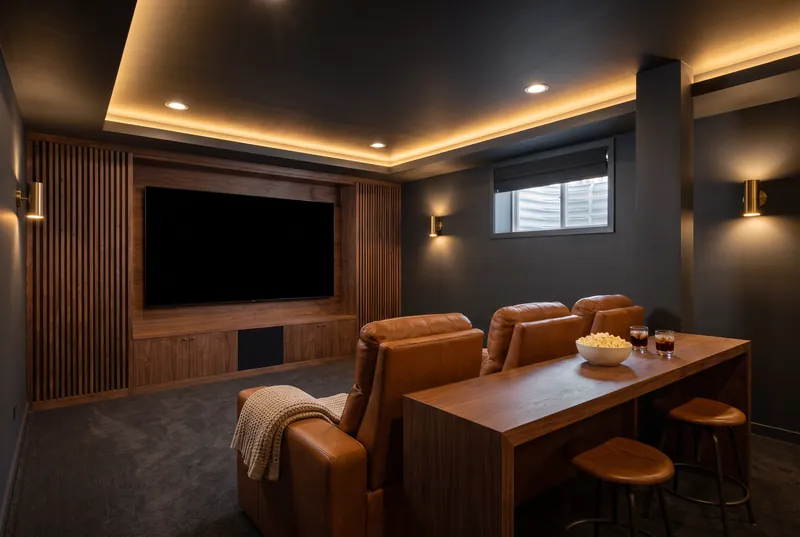
Ducts and beams that drop into the room become soffits, and a soffit is the right place to hide speaker wire and cove lighting. A media wall with built in cabinets and an electric fireplace is the usual answer for a family room that doubles as a theater.

What the job includes

  • Insulation in the ceiling and walls for sound
  • A dedicated circuit for the equipment
  • Conduit for display, speaker and network cables
  • Recessed, cove and sconce lighting on dimmers
  • Media walls with built in cabinets
  • Soffits that hide ducts, beams and wiring
  • Carpet or plank flooring suited to the slab
  • Electrical permits and inspections

Basement ideas

Home Theaters and Media Rooms Ideas

Design examples for Chicago area basements. Open any photo for a closer look.

Planning notes

What to Know Before You Start

1Keeping the sound down here

Sound travels through the joists and the ducts. Insulation in the ceiling bays, a solid door, and sealing the gaps around the room do most of it. Where you want more, the drywall can be mounted so it does not touch the joists directly.

Supply and return ducts carry sound too, so we plan their runs with the room rather than around it.

2Power, wiring and light

Equipment wants its own circuit, and an electric fireplace in a media wall usually wants its own outlet. Every device needs space to breathe, so the cabinets are built with ventilation in mind.

Lighting does a lot in a room with no daylight. Cove lighting in a raised ceiling, sconces on the side walls and recessed lights on separate dimmers let the room work for a film, a game or a party.

Local rules worth knowing

GlenviewGlenview's electrical amendments require low voltage wiring to run in conduit wherever finished walls or ceilings make it inaccessible, which covers speaker and video runs in a theater.
NorthbrookNorthbrook needs no permit for residential low voltage installations, but new outlets and circuits for a home cinema do, and Romex is not allowed for them.
Highland ParkHighland Park's permit exemption for low voltage covers work under 25 volts that cannot supply more than 50 watts, and line voltage circuits for a theater room cannot be Romex, BX or metal clad cable.
HomewoodHomewood bans unvented gas log heaters and unvented room heaters, so a fireplace in a basement theater has to be a vented unit.

Common questions

Home Theaters and Media Rooms FAQ

How do you keep theater sound from carrying upstairs?

Insulation in the ceiling and walls, a solid door and sealed gaps do most of it. For more, the drywall can be mounted so it does not touch the joists. Ducts carry sound too, so we plan their runs with the room.

Does a basement theater need its own circuit?

It should have one. Amplifiers, displays and consoles on a dedicated circuit are not sharing a line with a freezer or a dehumidifier. Electrical work needs a permit, and we pull it.

Can a basement with a low ceiling work as a theater?

Usually. Recliners sit lower than you think, and a soffit around the edge with cove lighting can make a low ceiling feel deliberate. We measure the finished height before the room is designed.

Free estimate

Ready to Talk About Home Theaters and Media Rooms?

Fill out the form and we will call to set a time to look at your basement. The estimate is free and there is nothing to sign.

Name, phone and ZIP are all we need. We call to set a time for the estimate.